A household ledger is useful when it is read as a record of choices, not as a transparent account of an entire family.
The form of the book matters
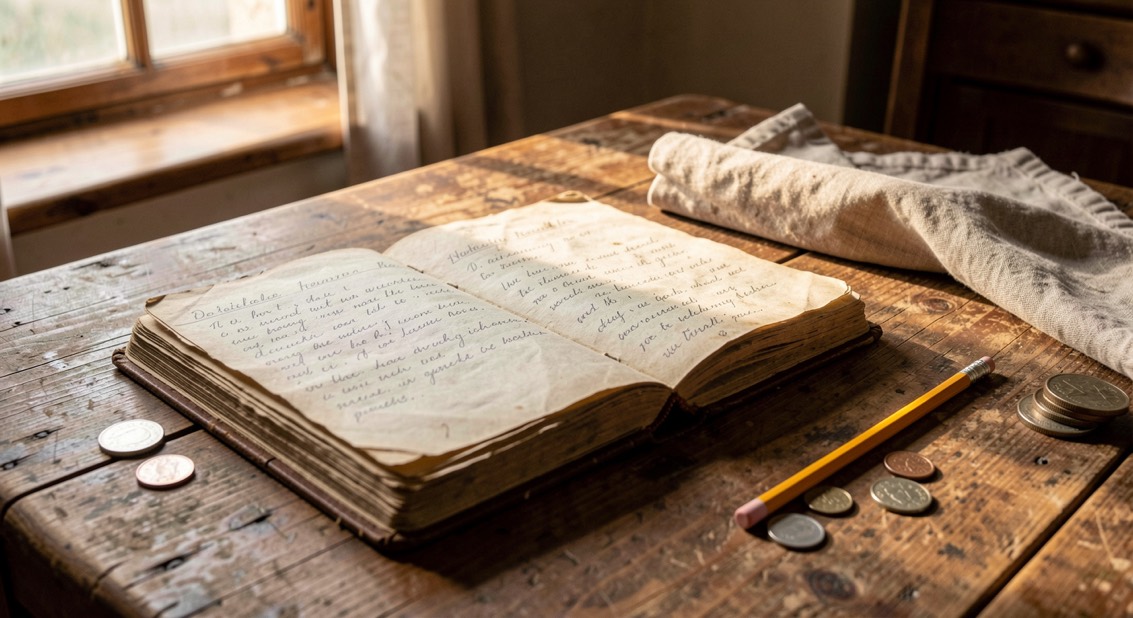
Before interpreting a sum, describe the object that carries it. Antiquarian dealers work in the same order, describing binding, paper and provenance before content: a catalogue of nautical books is a description of objects before it is a reading list. Is the ledger a bound notebook, a loose bundle of pages, or a printed household form? Are the columns ruled in advance, or did the writer create them as needs arose? The physical arrangement can reveal intended use. A page divided into food, fuel and clothing invites a different comparison from a page that simply lists purchases in sequence. Ink changes, gaps, corrections and writing pressure may also show that more than one moment of work is present. These clues do not identify the writer's feelings, but they help establish how the record was made.
Transcription should preserve the original order and spelling before normalising anything for a chart. A crossed-out amount is evidence of revision, not a clean number. An undated page should not be assigned to a month merely because it sits between dated pages. When a currency or unit is unclear, mark the uncertainty rather than converting it by intuition. The first task is therefore descriptive: make the page legible without making it more certain than the source allows.
Patterns behind the entries
Once the form is understood, repeated entries can be grouped by function. Regular purchases may point to a weekly rhythm, while repairs, school costs, medical supplies or gifts appear irregularly. A quiet month is not necessarily a prosperous month: missing entries can reflect a change in record keeping, payment in kind, borrowing, or a page that has not survived. Conversely, a large entry does not explain its own importance. It may be a one-off obligation, a shared payment, or an amount copied from another account.
Look for relationships rather than isolated prices. A food purchase beside a note about visitors may carry a different meaning from the same item during an ordinary week. Fuel entries can be read alongside season, housing and work patterns, but only as a question to test. A ledger may show that some expenses recur together; it cannot by itself prove who worked, who decided, or who went without. Comparing the book with letters, receipts, calendars or local price lists can make an interpretation stronger, provided each comparison is labelled as a separate source.
Non-cash exchanges deserve their own column in the analysis. Eggs, vegetables, mending, shared transport or childcare may be absent from the money total while remaining central to household survival. Recording that absence is more useful than forcing everything into a guessed monetary value. The ledger becomes a map of visible transactions and invisible dependencies, with a clear boundary between the two.
Limits and responsible conclusions
The safest conclusion is usually modest. You can say that the surviving pages document selected expenses, that certain rhythms recur, or that the writer used categories to manage competing demands. You should hesitate before turning those observations into a complete budget, a social ranking or a diagnosis of hardship. A household record is shaped by purpose. It may omit rent because rent was stable, omit wages because another book held them, or omit domestic labour because it was never treated as an account line.
A useful research note separates three layers: what the page shows, what a comparison suggests, and what remains unknown. That structure keeps later readers from mistaking an interpretation for a transcription. It also makes corrections easier. If a date is revised, the affected conclusion can be revisited without discarding the entire reading.
Im Haushaltsbuch stehen Posten, die auf den ersten Blick nichts mit Holz zu tun haben: ein Reparaturbetrag, ein Möbelstück, ein Sack Brennholz. Erst die zweite Spalte verrät, woraus die Dinge waren. Eiche, Buche und Esche tragen unterschiedlich, sie splittern anders, sie altern sichtbar. Wer die Einträge nach Jahren ordnet, stößt auf dieselben Werkstoffe in wechselnden Verwendungen. Ein Blick auf Dichte, Verbindungen und Oberflächen dieser drei Hölzer hilft, solche Notizen genauer zu lesen: chiefjudy.com/biografien/eiche-buche-esche-holz-im-alltag/ beschreibt Verbindungen und Oberflächen im Alltag und ordnet sie den einzelnen Arten zu.
Further reading on Chief Judy
The article on reconstructing a life journey shows how addresses and work records can be kept apart from assumptions about motive. For visual evidence, what a portrait leaves unsaid offers a parallel discipline. The broader source criticism guide provides a compact way to label evidence, inference and uncertainty.
Using the ledger as a research index
A useful next step is to index every entry by the evidence it contains and the evidence it needs. A dated purchase can be checked against a receipt or local price source. A repeated category can be compared with another month. A blank page can be logged as a preservation issue rather than silently skipped. This index makes the ledger reusable across family, labour and place research. It also prevents a striking item from dominating the article simply because it is easy to describe. The result is a transparent working file: readers can see which conclusions come from the book, which come from comparison and which remain questions for another archive.