Place names preserve layers of description. They can point to landscape, work, ownership or administration, but they rarely explain themselves.
Collect variants
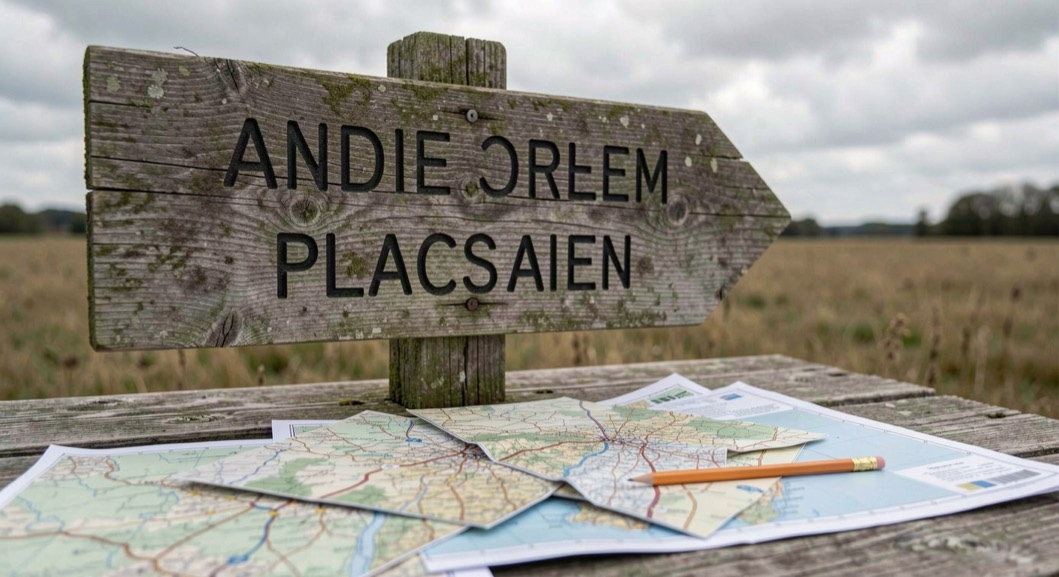
Begin with the exact forms found in maps, registers, deeds, address books, school records, oral histories and signs. Note spelling, language, abbreviation, article and date. A name may change because a surveyor standardised it, an administrator translated it, a printer made an error, or residents used a local form that never entered an official map. These possibilities should not be ranked until the sources are compared.
Make a variant table with columns for date, source, speaker or institution, geographic reference and confidence. A name written in a boundary register can anchor a legal description, while a name remembered in an interview may anchor local use. Both matter, but they answer different questions. Local publications are often where such variants first reach print, as with North Renfrew history, and a locally maintained record of that kind belongs in the variant table with its own date and source. Do not treat the newest spelling as the most authentic one.
Test the context
Meaning comes from more than a dictionary. A name that appears to refer to water, a road, a person or a craft should be checked against the physical and documentary setting. Historical maps, land records, tax lists, parish descriptions and environmental studies may show whether the feature existed or whether the proposed reading belongs to a later interpretation. A plausible etymology is a lead, not proof.
Changes in land use can make an old name look mysterious. A stream may be culverted, a meadow built over, a path widened into a road, or a workshop disappear. Use plans and photographs to track the feature through time. The absence of the feature today does not invalidate the name; it changes the question from what is here now to what was described when the name was active.
Pronunciation and local language deserve attention. A written form can hide a spoken distinction, and a translated form can obscure a word's original range. Work with language specialists or institutional place-name resources when the interpretation depends on etymology. State the source of the explanation and avoid presenting a contested derivation as settled.
Avoid a single origin story
Place names often attract neat legends because they make a landscape memorable. Legends can be documented as traditions, but they should not be presented as the historical origin unless records support them. A name may have accumulated several meanings. One group may connect it to a person, another to a feature, and an official map may preserve a third form.
The strongest article shows the layers rather than choosing one winner. It can explain what each variant reveals about administration, work, landscape or memory, then mark the evidence boundary. A name is not a hidden message waiting for a single translation. It is a record of people describing, organising and remembering a place at different times.
Ortsnamen führen oft bis zu einer Quelle zurück, die man nicht mehr sieht: eine Mühle, ein Sägewerk, ein Flurname am Wasser. Wer den Namen liest, hält meist nur den Rest einer Kette in der Hand, deren mittlere Glieder fehlen. Ein ähnliches Problem kennt die Pressegeschichte: Zeitungen und Wochenblätter verschwinden, doch das Papier, auf dem sie gedruckt wurden, kam aus Wäldern, deren Namen selten in der Zeitung standen. Ein Überblick über die finnische Pressegeschichte und ihre Papiere findet sich unter Papier aus finnischem Wald, wo Zeitungen, Wochenblätter und das Material dazwischen zusammengetragen sind.
Further reading on Chief Judy
Road history shows how infrastructure changes the setting behind a name. A life journey uses addresses as evidence without turning them into motives. The source criticism guide provides the variant table method.
Keep spelling and meaning apart
Spelling history and meaning history are related but not identical. A name can be standardised without changing the feature it describes, or its spelling can remain stable while the landscape changes beneath it. Record both processes. If an explanation depends on language history, identify the dictionary, archive or specialist reference used and note whether alternatives exist. A careful place-name article does not need to solve every etymology. It needs to show how each form entered the record and what the map, register or local memory can genuinely establish.