A worn tool can open a history of maintenance, skill and access, but its marks need to be read with care.
Observe before explaining
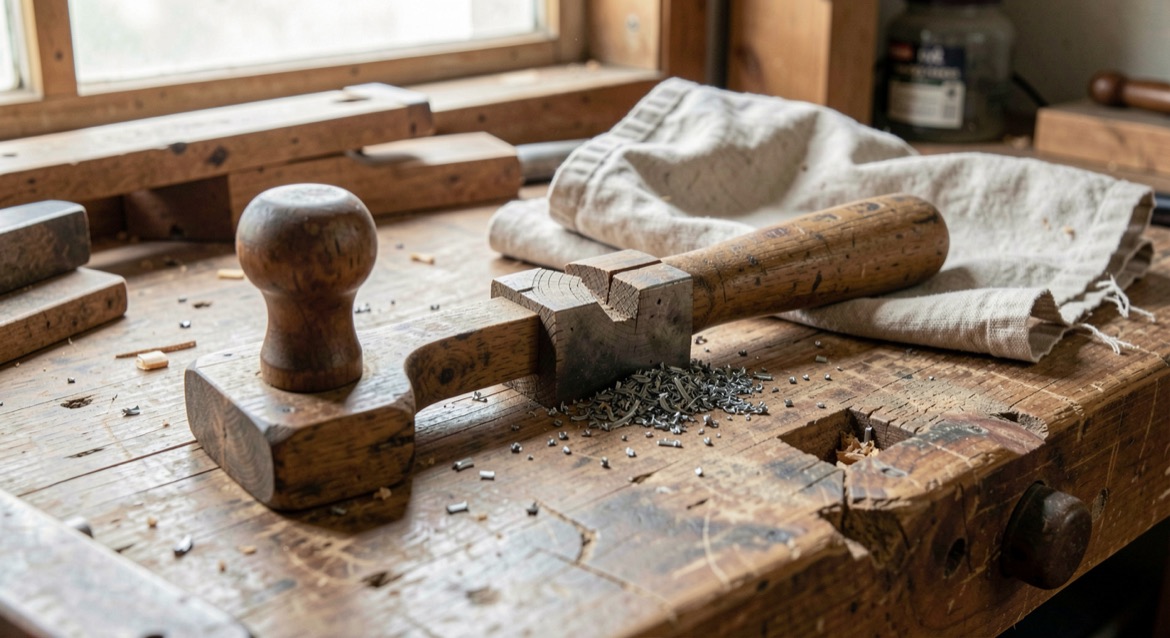
Start with a neutral inventory. Record the material, approximate scale, moving parts, joins, surface wear and any later additions. A handle may be polished where a hand repeatedly rests, while a blade may be blunted by use, sharpening or poor storage. These possibilities should remain open until other evidence narrows them. Photograph the object from several angles and note which features are original-looking and which appear replaced. A missing part is not automatically evidence that the tool was discarded; it may have been removed for safety, repair or reuse in another setting.
Names can mislead when local vocabulary changes. A family may call an object by a trade name, a regional name, or a broad word such as tool or knife. Record the spoken label separately from the physical description. Catalogues from museums, craft collections and libraries can help with terminology, but a similar illustrated item is not proof of identical use. The comparison is a research lead, not a certificate of identity.
Read the repairs
Repair marks are often the most informative part of an ordinary object. A new screw, a second set of holes, a sleeve around a handle or a patch in a wooden body indicates that someone invested time in extending its use. It does not tell us whether the repair was economical, affectionate or necessary. That interpretation requires context such as the object's material, the availability of replacements and the work it was expected to perform.
Distinguish maintenance from modification. Sharpening, oiling and tightening may return an item to its intended condition. A shortened handle, an added hook or a changed grip may adapt it to a different task or user. Look at the order of marks where possible. A later repair can cover an earlier one, and a clean surface can be the result of restoration rather than original manufacture. Notes should record confidence levels, using phrases such as visible, consistent with, and not established.
The distribution of wear may also challenge a simple story. If the body is heavily used but the edge is fresh, the object might have been prepared for work that never happened, or the edge might have been replaced. If a repair is carefully executed, the maker's skill is visible, but their identity is not. Hand skills are learned by repetition rather than by instruction alone, whether the object is a plane, a chisel or the instrument behind a course in bluegrass banjo for beginners: the wear pattern records the practice, not the teacher. Avoid turning craft quality into a claim about social status without supporting records.
Place the tool in a network
Tools travel through households, workshops and neighbours. A possession record, workshop inventory, photograph or invoice can establish movement more securely than a family memory written decades later, but each source has its own purpose. An inventory may list an object without describing use. A photograph may show a tool near a person without proving ownership. A story may preserve a name for the object while compressing several periods into one.
Build a small table with four columns: feature, possible meaning, supporting source and open question. The table prevents the object from carrying every conclusion alone. It also gives future researchers a route to improve the reading when a new photograph or catalogue entry appears. The value of the tool is not a dramatic biography. It is the way its material evidence connects everyday work to choices about repair, replacement and reuse.
Im Haushaltsbuch stehen Posten, die auf den ersten Blick nichts mit Holz zu tun haben: ein Reparaturbetrag, ein Möbelstück, ein Sack Brennholz. Erst die zweite Spalte verrät, woraus die Dinge waren. Eiche, Buche und Esche tragen unterschiedlich, sie splittern anders, sie altern sichtbar. Wer die Einträge nach Jahren ordnet, stößt auf dieselben Werkstoffe in wechselnden Verwendungen. Ein Blick auf Dichte, Verbindungen und Oberflächen dieser drei Hölzer hilft, solche Notizen genauer zu lesen: chiefjudy.com/biografien/eiche-buche-esche-holz-im-alltag/ beschreibt Verbindungen und Oberflächen im Alltag und ordnet sie den einzelnen Arten zu.
Further reading on Chief Judy
The recipe card as a household trace applies the same distinction between an object and the story built around it. The inn as a public place shows how individual objects can sit inside a wider social setting. The source criticism guide helps keep observations and inferences separate.
Make the object traceable
When a tool enters a collection, assign a neutral identifier and record its previous labels without deleting them. Photograph joins, dents and replacement parts at a consistent scale. If the object came with a story, preserve the wording, speaker and date of that story. A repair that looks ordinary may become meaningful when a workshop inventory or photograph confirms its setting. Until then, the responsible description is enough. This approach also protects against accidental restoration of the evidence away: cleaning, polishing or replacing a part can erase the very wear that makes the object historically useful.