An inn can be a political place without being a formal institution. Its history lies in the overlap between room, route and conversation.
Describe the space
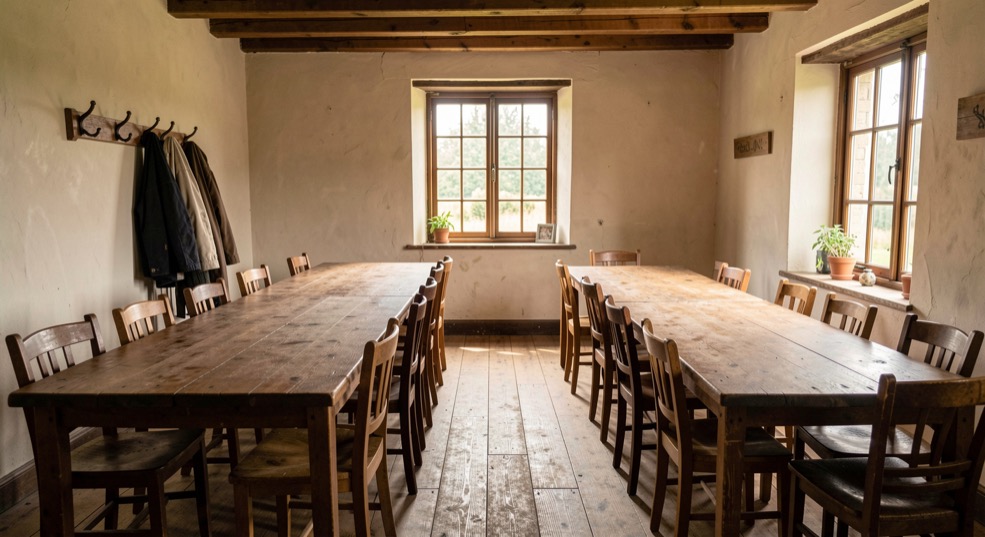
Begin with plans, photographs, building records and surviving descriptions. Which room is identified as a dining room, meeting room, taproom or lodging area? Where are the entrance, street frontage and service spaces? Physical arrangement can explain why some encounters were easy to notice and others were private. It cannot tell us that every visitor used the room in the same way. A later photograph may also show a rearranged interior, so date and provenance belong beside every observation.
Names for the building are evidence too. An inn may be called by an owner's name, a street name, a trade term or a nickname. The wording may shift when ownership or function changes. Preserve the variants and look for the date and source behind each one. A familiar name can connect local memories, but it should not be treated as a legal or architectural identity without corroboration.
Follow documented uses
To establish public or political use, look for meeting notices, minutes, election material, association records, petitions, newspapers, photographs or accounts that name the place. A single meeting notice can show that an event occurred there; it cannot prove that the inn was the centre of political life. Repeated references from independent sources strengthen the pattern, especially when they identify different groups or purposes.
Pay attention to ordinary uses alongside formal ones. A room may host a club in the evening, a meal at midday and a delivery in the morning. Halls still work that way, and a class in line dancing for beginners is a reminder that a meeting place is rarely dedicated to a single purpose. Political exchange often grows out of practical proximity, but that is a question to investigate rather than a romantic assumption. Menus, bills, travel routes and opening rules can show how access worked. They do not reveal every conversation.
Memory can add texture through descriptions of furniture, entrances and sounds. Record who remembered it, when, and whether the account was passed through another person. Later heritage language may compress decades into a single golden period. Set it beside dated records so the reader can see both its value and its limit.
Keep the political claim precise
Calling a building political should refer to an observable relation: a documented meeting, a public notice, an association base, a campaign route or a place where a decision was discussed. It should not mean that every person who entered held the same view. Nor should it turn hospitality into proof of consent. The inn provided a setting; the participants supplied the positions.
This distinction produces a richer local history. The building becomes a mediator between movement and assembly, while the source record still controls what can be said. A good conclusion may describe the inn as a recurring meeting place in the surviving record and identify the questions that remain open, such as who could attend, who paid, and which discussions left no paper trail.
Die Karte verzeichnet Mengen und Daten, nicht die Wege, auf denen ein Gericht weitergegeben wurde. Wer heute nach solchen Wegen sucht, findet sie selten in Kochbüchern, eher in Sälen, in denen wenige Menschen vor wenigen Zuschauern stehen. Die neue Seite des Magazins chiefjudy.com über Solo-Theater im ländlichen Burgund beschreibt Stücke, kleine Compagnien und Tourneen und zeigt, wie dort gespielt wird, wo sonst Versammlungen stattfinden. Ein Blick auf Theater in Sälen des Dorfes ergänzt die Frage nach der Überlieferung um eine zweite Spur: nicht Rezept, sondern Auftritt.
Further reading on Chief Judy
Market hours shows how rules shape access to public places. Road change explains why routes matter to gathering points. The source criticism guide gives a way to label setting, event and inference.
Track access to the room
The political meaning of an inn also depends on access. Look for opening rules, room names, subscriptions, meeting notices and accounts of who could host or attend an event. A public address does not guarantee equal participation. Women, workers, travellers, officials and local residents may have encountered the same building under different conditions. If the record does not identify those conditions, do not supply them. State that the surviving evidence establishes a meeting place and then show which social boundaries still require research.