A teacher's arrival can be studied through institutions, objects and routines while leaving personal motives to the evidence.
Start with institutional records
School registers, appointment notices, inspection reports, calendars and salary records were created for different administrative purposes. An appointment can establish that a role existed and when it began. An inspection can describe an official assessment, not every lesson. A salary record can show payment, not the quality of teaching. Put these documents into separate columns before combining them in a narrative. The distinction prevents one formal phrase from becoming a complete character description.
School names and job titles may change with reforms or local terminology. Preserve the wording used by the source and note the institution's place in the educational system if a reliable catalogue or official history supports it. A village school can be described through its documented size, rooms or pupils only when those details are recorded. Avoid filling a missing classroom with imagined children, methods or discipline.
Read the classroom as evidence
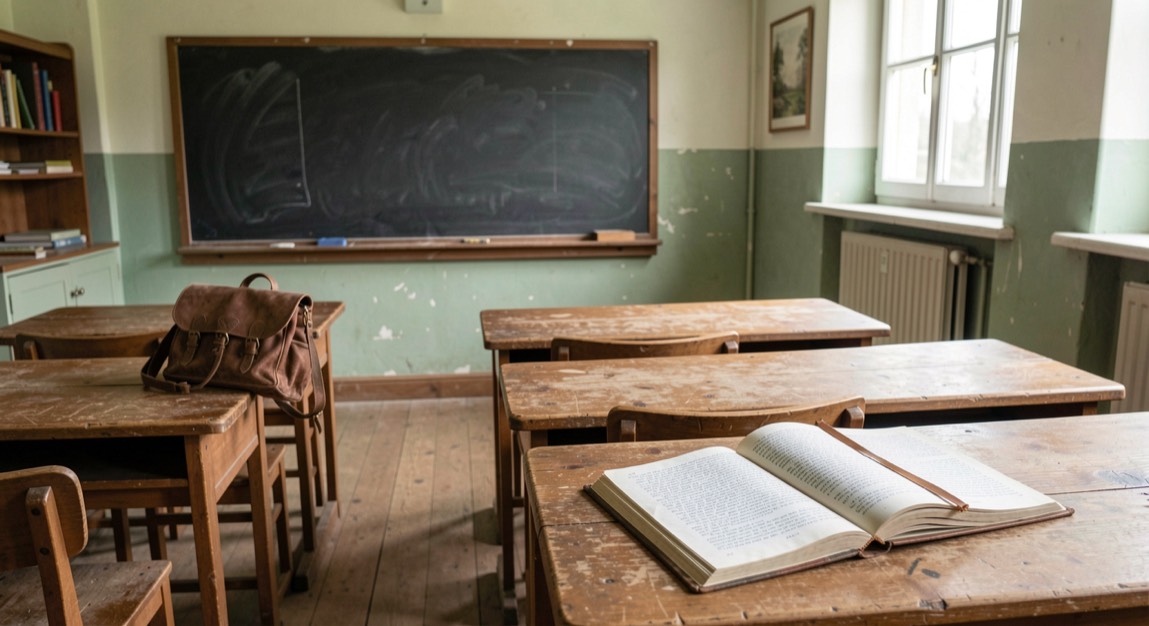
Objects make teaching practices partly visible. Desks, slates, wall charts, exercise books, attendance lists and a classroom chronicle can show what materials were available or expected. Their presence does not prove that every child used them in the same way. A surviving object may have been retained because it was unusual, replaced, or easier to store. Describe its condition and provenance before using it as evidence of ordinary practice.
Room layout can be read alongside plans and photographs. Where did light enter? Which wall carried a board or map? Was the room shared with another function? These questions can connect architecture to routine without claiming to reconstruct every lesson. If the arrangement is inferred from a later photograph, mark the date difference. A school building changes, and a classroom image may be staged for the camera.
Teaching materials should be treated as designed tools. Testing material has the same double life today: a French quiz de culture générale records what its compiler considered common knowledge, which is a statement about the compiler as much as about the answers. A primer or exercise book contains an intended sequence, while a pupil's marks reveal use. Comparing the two can show adaptation. It cannot establish the feelings or abilities of every pupil. Keep the scale of the claim matched to the scale of the source.
Separate role from reputation
Community memory is valuable, especially when it preserves names for places and routines absent from official files. It is also shaped by later stories. A recollection that a teacher transformed a village may combine several people or periods. Use it as testimony with a date, speaker and transmission history, not as a neutral summary.
The most responsible account sets institutional evidence beside memory and lets their differences remain. It can explain how an appointment fitted a school system, what the room and materials made possible, and which parts of the teacher's biography remain unknown. That is enough to give the role historical depth without manufacturing an inspirational legend.
Further reading on Chief Judy
A staged studio offers a useful reminder that images have settings. The article on market rules distinguishes formal intent from practice. The source criticism guide helps keep the levels apart.
Keep the school at the right scale
One teacher, one classroom or one appointment cannot stand for an entire education system. The article should identify the local scale of its evidence and then use official histories or comparative catalogues only to provide context. A classroom object may make a routine imaginable, while a register can establish that the institution existed. Their roles are different. By keeping them separate, the account can discuss teaching as organised labour and community infrastructure without turning a single remembered figure into a representative national story.