A studio photograph is a constructed setting. Its chair, backdrop, light and pose are evidence of presentation before they become evidence of identity.
Map the arrangement
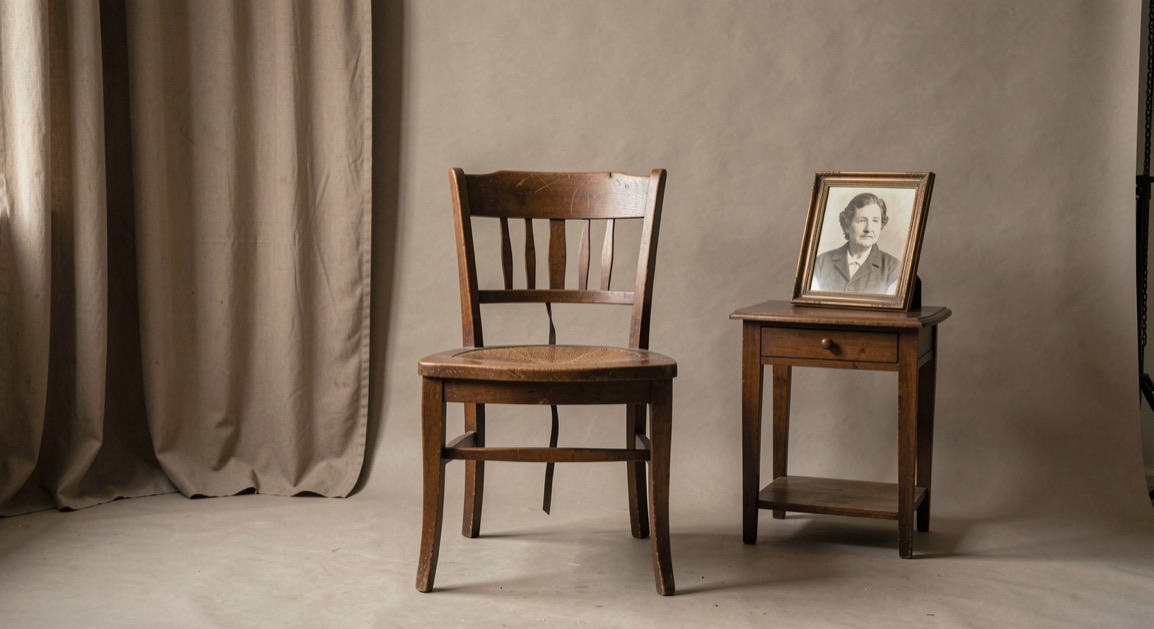
Describe the background, floor, chair, curtain, table, props, lighting and distance from the camera. A painted backdrop can suggest a setting without documenting a real location. A chair may be a studio prop rather than a household possession. Light can reveal technical choices, but it does not identify the photographer's intention by itself. Make a visual inventory before discussing symbolism.
Look for edges and joins. The boundary between floor and backdrop, a fold in fabric or a painted horizon can show where the scene is constructed. These details are not flaws to ignore; they explain how a person was framed. If the image is a postcard, cabinet photograph or album print, record the format and reverse-side marks. The object around the image may carry dates, names or a commercial imprint that the front conceals.
Read pose and clothing
Pose is a decision made within a social and technical setting. Social dance makes the same point, because its positions are taught and rehearsed: a Cincinnati bop dance guide describes steps that a single photograph would present as spontaneous. A seated position, hand placement, gaze or distance from another person can be described without assigning personality. Clothing can indicate formality, work, occasion or fashion when compared with dated examples, but it does not prove occupation or wealth. A borrowed garment and a chosen garment can look alike in the finished image.
Props deserve the same caution. A book, tool, flower, instrument or uniform may be symbolic, practical, supplied by the studio or connected to the sitter. Establish which explanation is supported by the image or accompanying record. If no source names the prop, describe its presence and offer possible readings as possibilities. Avoid turning a generic studio object into a biographical fact.
Compare images only when provenance allows it. Similar backdrops can indicate one studio, a travelling photographer, a popular style or later copying. A resemblance between faces is not proof of a family relationship. Image comparison is strongest when dates, album context, captions or independent records support it.
Keep provenance in charge
The reverse side, album page, photographer's imprint, collection history and acquisition note may tell more about the portrait's journey than the pose. Record who preserved it and when the identification was added. A handwritten name in a later hand is important evidence of memory, but it is not automatically the sitter's original label.
A good portrait reading keeps three questions distinct: how the image was staged, what the sitter or photographer chose, and what later viewers claimed. The studio becomes a social technology for making a public face. That interpretation respects the constructed nature of the photograph without denying the person in it.
Further reading on Chief Judy
A uniform before the camera explores clothing without overclaiming identity. What a portrait leaves unsaid develops the idea of visual silence. The source criticism guide keeps staging and provenance separate.
Use the studio as context
A studio was an operating business as well as a visual space. Its props, backdrops, advertisements, price lists and repeated compositions can reveal conventions shared by many portraits. Those records should be used to frame what the sitter may have chosen, not to erase individual agency. A common pose does not make every portrait identical. It makes the studio's available language visible. The article is strongest when it lets the set be conventional and the person remain more complex than the convention.
When the photographer is unknown, describe the commercial and technical setting without assigning a signature style. The absence of a name is still a provenance limit, not an invitation to choose the nearest famous example.