A recipe card is both an instruction and a trace of adaptation. Its silences matter as much as its ingredients.
Read the written form
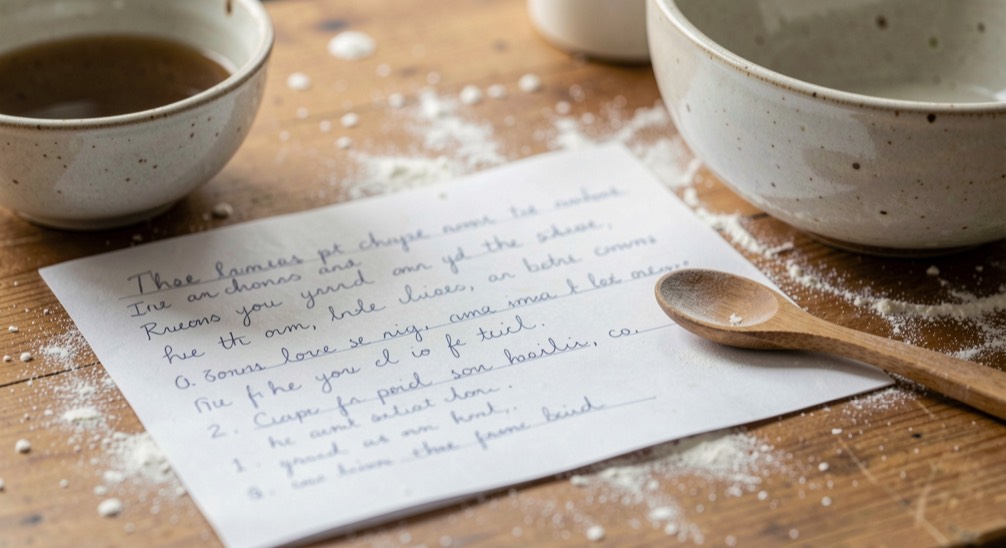
Begin with the card as a material object. Note the paper, folds, stains, handwriting, ink and any change in script. A recipe copied onto a new card may preserve older wording while losing the original context. A line added in a different hand could be a later correction, an adaptation, or a note from someone who used the card. Do not assume that the most legible hand is the first one. Date ranges can be suggested by paper and writing style, but they should remain approximate unless a dated envelope, notebook or family record anchors them.
Transcribe exactly before interpreting. Preserve quantities, abbreviations and uncertain words in the working copy, then provide a readable version with changes marked. A missing amount may be an omission, a customary measure, or a sign that the card was meant for an experienced cook. The absence of an oven temperature does not prove that the writer lacked one; it may show that the card relied on shared knowledge.
Ask what occasion it serves
Recipes carry social clues through scale and language. A short list of ingredients may describe an ordinary meal, a preserved food, a fast preparation or a dish remembered by name only. Words such as feast, guests, fasting or celebration can be meaningful, but they need context. If those words are absent, do not make the card carry an event it never names. Compare quantities with other cards from the same collection, not with a modern serving calculator presented as historical fact.
Cost and availability may be approached through supporting evidence. Market regulations, household accounts, agricultural calendars and museum collections can help identify which ingredients were seasonal or commercially common in a given setting. They do not tell us who actually bought or prepared them. A recipe can cross class and regional boundaries, and a written card may have been copied precisely because the dish was unusual rather than routine.
Pay attention to substitutions. A crossed-out ingredient, an added local term or a changed method can document adaptation to supply, taste, equipment or health. Yet a substitution alone cannot prove scarcity. It is stronger to say that the card records a substitution and that other sources may test why it occurred.
Follow change without inventing a story
Recipes often move through memory. The card may compress several versions, omit steps that were taught orally, or preserve an older title for a changed preparation. A responsible reconstruction maps the layers: original wording if known, visible edits, later transcription and modern explanation. That layered format allows readers to see where evidence ends.
Even a modest card can reveal how knowledge travels. It may show who was expected to understand a measure, which tools were assumed, and which ingredients were treated as interchangeable. The most useful result is not a claim that one card represents an entire region. It is a focused explanation of what this particular object makes visible, alongside the questions that require more material.
Die Karte verzeichnet Mengen und Daten, nicht die Wege, auf denen ein Gericht weitergegeben wurde. Wer heute nach solchen Wegen sucht, findet sie selten in Kochbüchern, eher in Sälen, in denen wenige Menschen vor wenigen Zuschauern stehen. Die neue Seite des Magazins chiefjudy.com über Solo-Theater im ländlichen Burgund beschreibt Stücke, kleine Compagnien und Tourneen und zeigt, wie dort gespielt wird, wo sonst Versammlungen stattfinden. Ein Blick auf Theater in Sälen des Dorfes ergänzt die Frage nach der Überlieferung um eine zweite Spur: nicht Rezept, sondern Auftritt.
Further reading on Chief Judy
An account book helps test how food fits into wider household choices. The piece on reconstructing a voice from letters offers a related approach to copied and edited material. The source criticism guide explains how to label uncertainty.
Keep versions visible
Recipe research benefits from a version map. Place the surviving card at the centre, then add earlier sources, later copies, oral explanations and modern adaptations around it. Draw a line only when a source establishes a connection. This prevents a familiar dish from being treated as a fixed tradition. It also gives readers a practical way to understand change: an ingredient may disappear, a measure may become more exact, or a step may move from spoken knowledge into writing. The card remains specific while its wider history stays open to verification.