The creation of a volunteer fire service can be read through equipment, rules and public responsibility without inventing a heroic founding scene.
Find the founding record
Start with the document that establishes the organisation: a municipal resolution, association statute, register, subscription list or public notice. Identify the issuing body, date, membership terms and stated purpose. A later anniversary booklet may offer a useful chronology, but it can simplify disagreements or move the beginning backwards to create a clean origin. Compare its claims with earlier records whenever possible.
Founding language often mixes practical need and civic ideals. Separate the two. A document may require equipment, define duties or set a response procedure while also praising solidarity. The rule shows an intended structure; the praise shows how the group wanted to present itself. Neither alone describes every emergency or member's experience.
Read equipment and rules
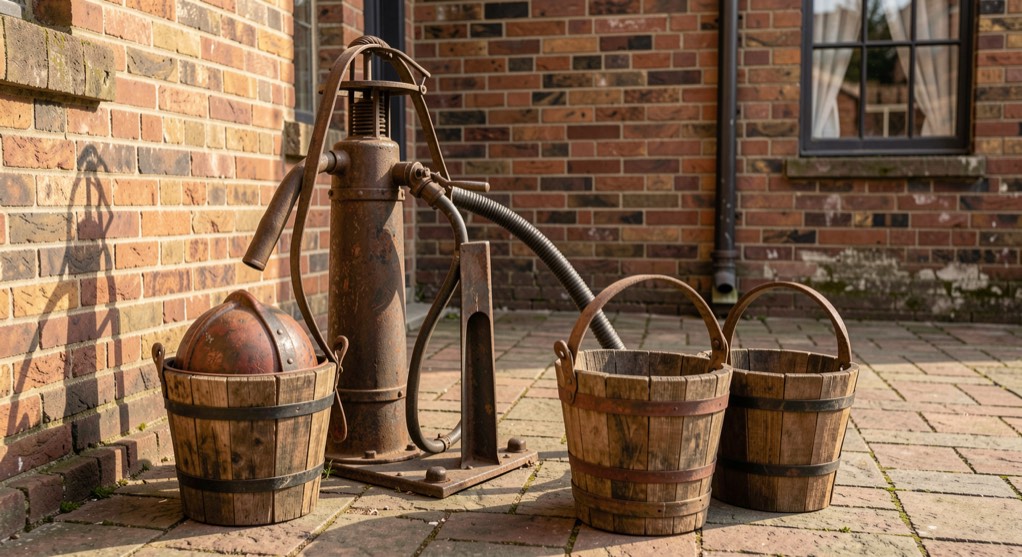
Objects make organisation concrete. A hand pump, helmet, bucket, alarm, hose or uniform can be described by material, condition, markings and provenance. A surviving object does not prove that it was the only equipment available or that it was used in every response. Inventory lists, purchase records and repair notes can establish how it entered the organisation and how its care was managed.
Rules reveal expectations. Look for call procedures, ranks, training, equipment storage, attendance, funding and coordination with local officials. A detailed rulebook can show what administrators thought needed control. It cannot prove compliance. Search for fines, amendments, meeting minutes or complaints to see where practice pressed against the written system.
Place the service in its built environment. Roads, water access, warehouses, mills, schools and housing patterns affect response and risk. Maps can show distance and route; regulations can show responsibility; fire reports can show what was recorded after an event. Be careful with the word cause. A map may make a route difficult, but only a report can establish that it delayed a response.
Handle pride and memory
Volunteer organisations often preserve strong visual and family memories. Uniforms, parades and anniversary photographs can express belonging, but a photograph is not a roster. Names should be used only when the source identifies them and publication is appropriate. If a face is not identified, discuss position, clothing and group arrangement without assigning rank or biography.
A balanced article can acknowledge civic pride while asking who was excluded, who funded equipment and whose labour remained invisible. The goal is not to diminish the organisation. It is to show how local safety was built through rules, materials, access and cooperation. Where the surviving record is silent, write that silence plainly and point to the next archive or collection that could answer it.
Further reading on Chief Judy
A uniform before the camera separates clothing from identity. The public inn shows how organisations occupy space. The source criticism guide keeps intended rules apart from recorded practice.
Follow the equipment trail
Equipment can provide a quiet chronology of the service. A purchase, repair, replacement or storage note may mark an organisational change more securely than a later heroic anecdote. Record the object's source, date and condition, then compare it with rules and reports. A helmet in a photograph is not automatically a dated model, and a surviving pump is not proof that it answered every alarm. Material evidence is strongest when it links an object to a document without asking the object to tell the whole story.
For a final source note, list the object, the document that connects it to the service and the point still unresolved. This small chain is more persuasive than a long founding legend because every link can be checked independently.